Virtual Yarns
Virtual Yarns is a proudly independent Scottish family business, driven by artistic freedom and a mission to inspire through beautifully made yarns and design.
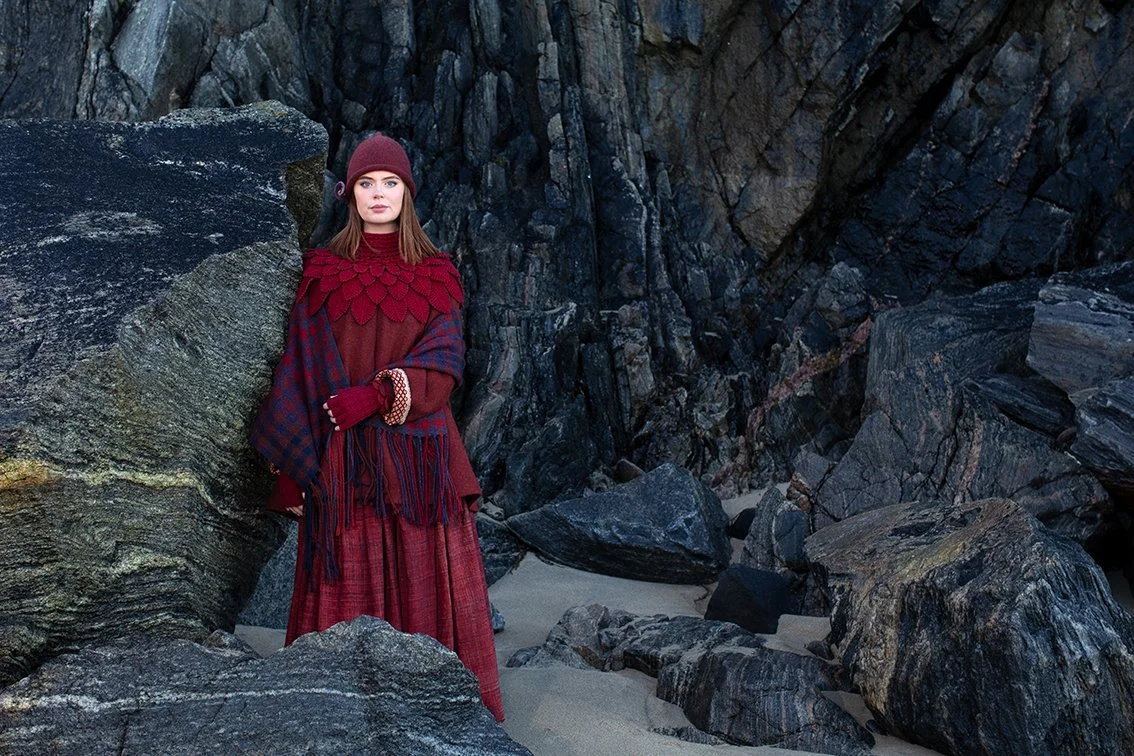
The Eagle Collar, Ruabhal Gloves, Oiseabhal Wrap and Hare Hat designs by Alice Starmore for Virtual Yarns. Harris Tweed coat and cotton skirt designed and made by Jade Starmore. Modelled by Emma MacRae. Photography by Jade Starmore.
Virtual Yarns - The St Kilda Project
“St Kilda sets the imagination on fire; its spectacular natural landscape, its wildlife, ecology, history and cultural heritage are so extraordinary that it is all too easy to become overwhelmed.
The aim of this project is to celebrate all these aspects of the archipelago through wearable art made in the medium of wool. It has taken time, thought and patience to let the kaleidoscope of inspirations resolve into a distinct narrative thread, but that process is complete and I can now outline the general drift of my thinking.
To begin the creative process I made some sketches in wool – knitted objects inspired by a variety of elements that would serve as initial pathways into the development of the narrative. Wool has always been essential to life throughout the Outer Hebrides, including St Kilda, where spinning, weaving, and knitting were of fundamental importance – not only for clothing but latterly as a form of income. For me as a Hebridean, creating works in wool has a satisfying thread of continuity to it.
Other experiences as a Hebridean also come into play.”
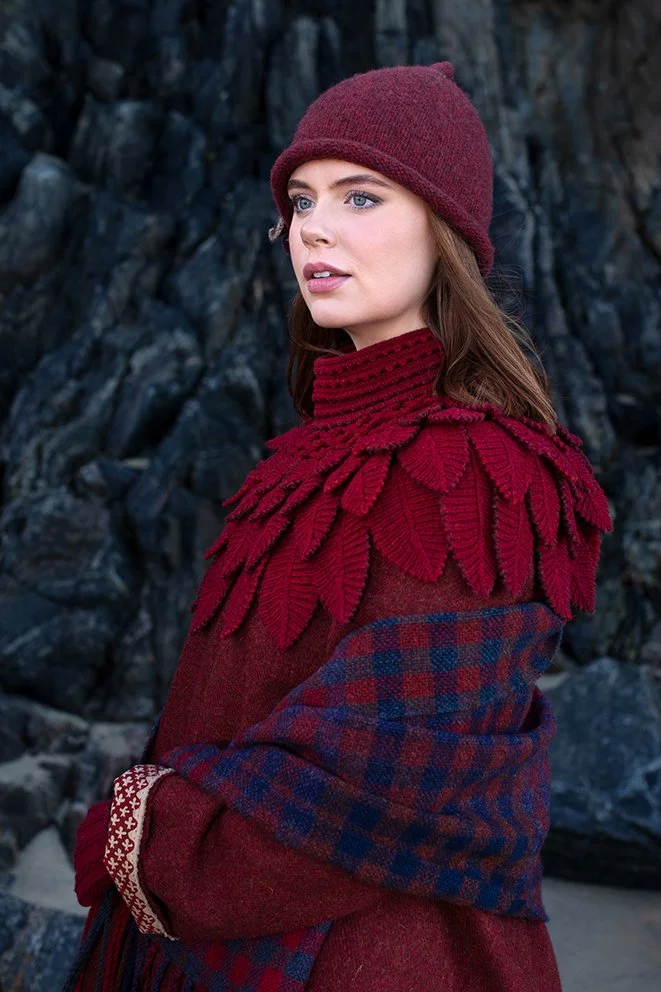
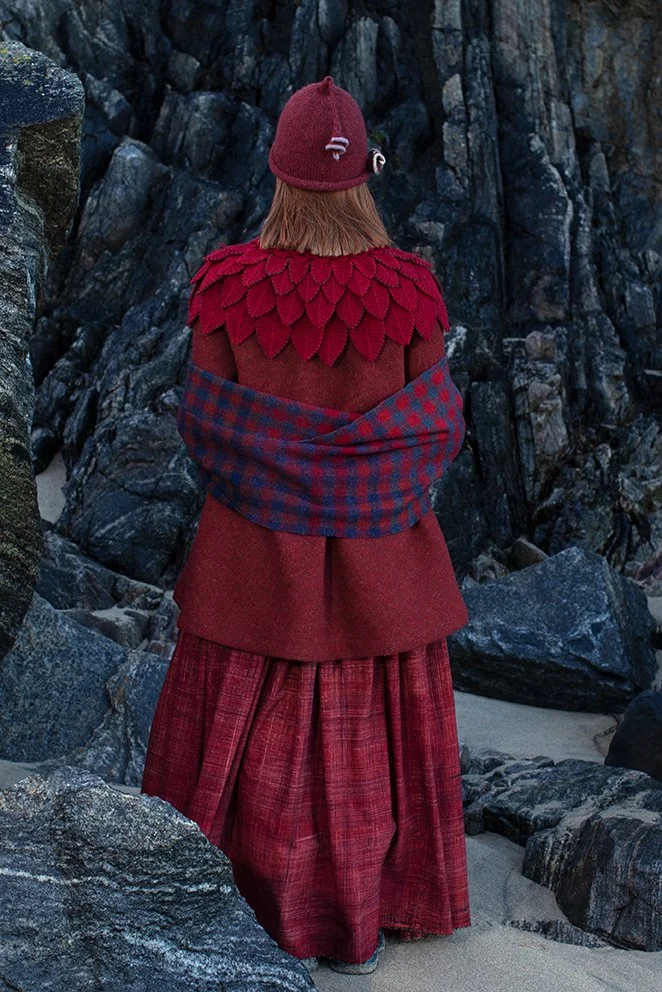
The Eagle Collar, Ruabhal Gloves, Oiseabhal Wrap and Hare Hat designs by Alice Starmore for Virtual Yarns. Harris Tweed coat and cotton skirt designed and made by Jade Starmore. Modelled by Emma MacRae. Photography by Jade Starmore.
A Hebridean Inheritance
“Growing up in Lewis with a St Kildan neighbour and my father’s many stories of his visits to St Kilda as a young fisherman, I received an early awareness of this legendary outpost of my Hebridean homeland. The impression I grew up with was that the St Kildans were our people but with an added dusting of something that seemed magical. My neighbour spoke Gaelic like we did but her accent and many of her words made it sound as though she sang rather than talked. Though they had been crofters, living in blackhouses and spending summers at the àirigh just like us, their daring feats on massive cliffs were no less awe-inspiring than those of any high-wire artist. They were people who survived not only on the far edge of our Hebridean world but on the very edge of possibility, between the highest cliffs and hardest rocks.”
Visiting Hirta and Gleann Mòr
“Therefore, my initial ideas for the project centred around these intriguing differences within the matrix of our shared culture and history, and I looked deeper into the stories, songs, and written history of St Kilda. But it was also important to visit the island to gain a true measure of how the people had lived with the resources they had. Of particular interest to me was a visit to the Gleann Mòr summer pasture. I have a strong sense of kinship with the women and girls who spent their summers on the àirigh tending to the animals, as I belong to the last Hebridean generation to take part in that form of transhumance. In Lewis the practice died out in the mid- 60s just as I entered my teens, but all of my childhood summers were spent at our family àirigh out on the moor. We lived intimately with the natural world, being a living part of it ourselves. Having the privilege of spending ten days on an NTS conservation work party on Hirta in 2019 brought home to me just how much more intense that intimacy would have been in a more confined and dramatic place.”
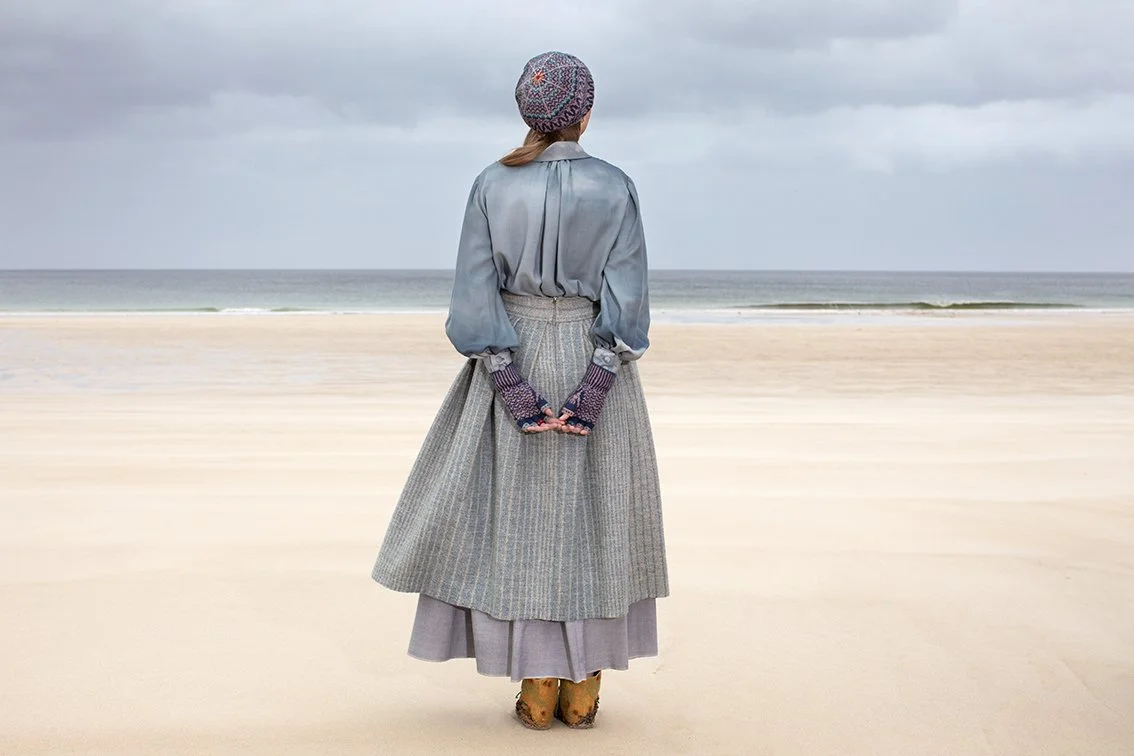
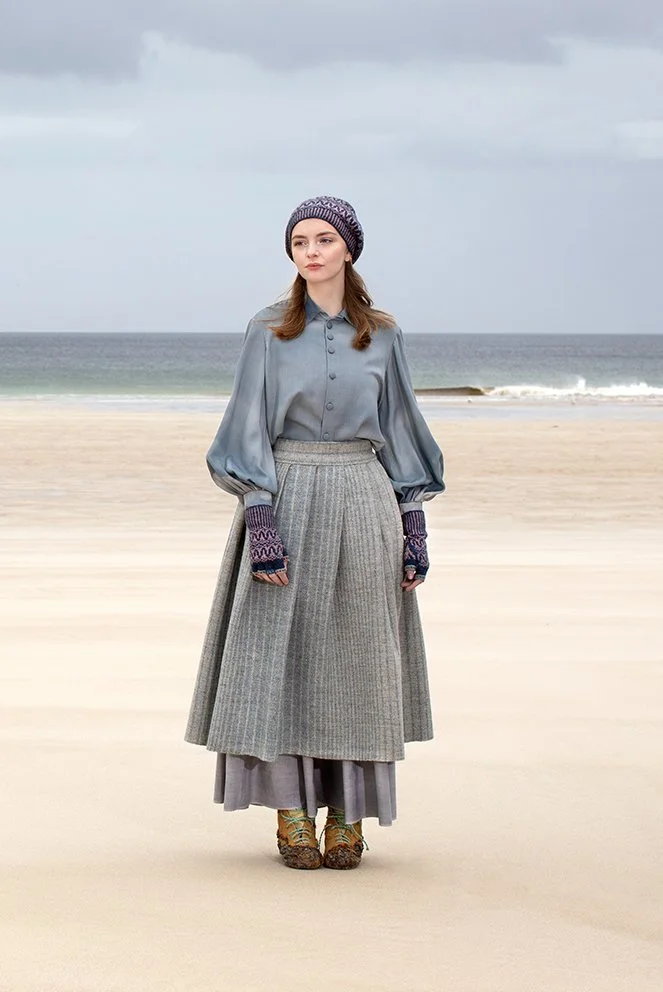
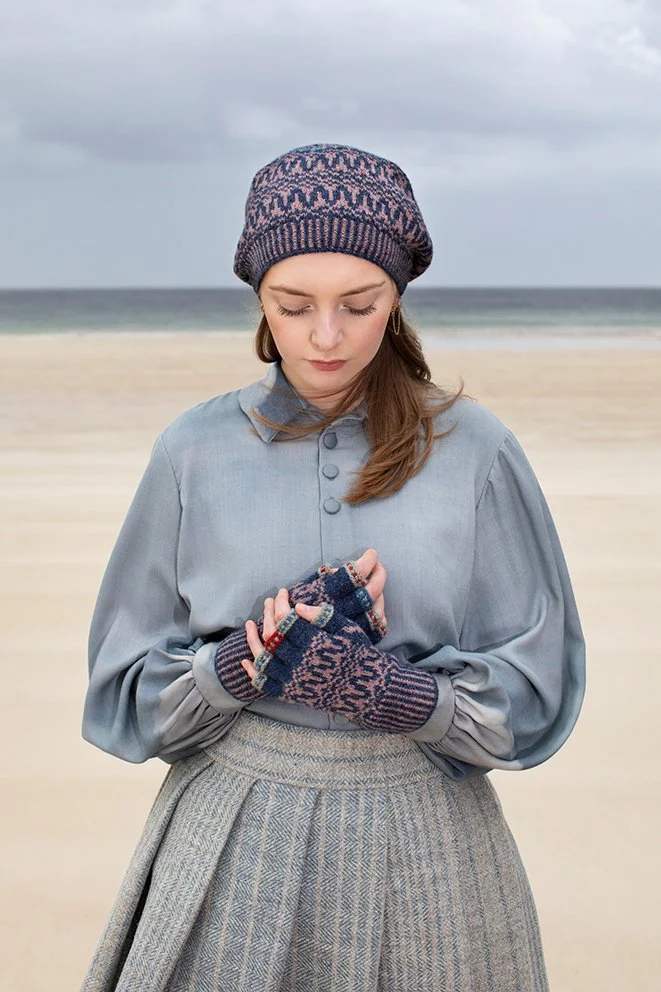
The Hirta Hat Set design by Alice Starmore for Virtual Yarns. Hebridean Sky shirt fabric designed and made by Jade Starmore, Harris Tweed skirt (Adabrock Tweed) and cotton underskirt designed and made by Jade Starmore. Boots designed and made by Deniz Uster of Otherscapes studio. Modelled by Iona Mairead Davidson. Photography by Jade Starmore.
On my return from that wonderful summer experience I spent time looking again at photographs and film of the last generation of St Kildans. The theme crystallised for me around one particular woman – I realised that Anne Mackinnon (née Gillies b. 1889) of Cottage no.1, where I had dined and enjoyed good company, appeared consistently throughout the span of available photographs: first as a single young woman; then knitting at her doorway; then with a companion in her churchgoing garb; and finally, footage of her with her young family of eight children just before the evacuation. Some photos are clearly set-up (for example, where she is showing off her knitted wares) but others capture genuine moments in her life, such as on her way up from the cliffs with some of her children, carrying a wreath of fulmar round her neck. And then another where she is sitting by the souterrain, working at her knitting while talking to a gentleman visitor.
These glimpses of Annie represent to me the heroic nature of all the women of St Kilda. Life for women of my grandmother’s generation in Lewis was particularly tough – the men did get some rest from daily and seasonal work, but women stopped only to sleep. But it is clear that life for St Kildan women was even tougher and more dangerous. As girls they climbed the cliffs to harvest eggs. They worked the land, tended the animals, hauled boats with the menfolk, bore children and were the main beasts of burden, carrying turf, birds and eggs up and down steep slopes.
They frequently looked like birds themselves, covered in plumage from their toil at feather plucking and, most spectacularly, wearing shoes of gannet-necks. It amazes me that they have inspired so few legends, but perhaps the answer to that notable void lies in an attitude behind the words of Martin Martin in his Late Voyage to St Kilda (c1695) where he casually dismisses the highly intriguing legend of a St Kildan woman who lived and operated a dairy in Gleann Mòr, known at the time as Gleann a’ Bhana-Ghaisgich (the Female Warrior’s Glen).
“... she is said to have been much addicted to hunting ... there are several traditions of this famous Amazon with which I will not further trouble the reader.”
He describes her house, Taigh na Bana-Ghaisgich (the Heroine’s House), as some hundred years old yet still extant and inhabited in the summer months. It is very telling that he is not interested in recounting anything further about this significant place or its legendary inhabitant, and he describes her hunting prowess as an addiction, as though it were a weakness, whereas the same prowess in men is invariably noted as masterful and heroic.
Most film scripts have a “log line” that reduces the potential movie to a single sentence. The log line for this project has crystallised in my mind as –
To celebrate the heroic lives of all the women of St Kilda, real and legendary, with suitably spectacular costumes made in the same medium through which they expressed their own creativity.
To this end, I am designing and making wearable art that will match the visual drama and intensity of the gannet slippers those women wore on their feet. The costumes will embody all aspects of their lives and legends, lived out in intimacy with their surroundings. My daughter Jade will design and make fabric and clothing to complement the costumes and will photograph them on location using a Hebridean models. Our aim is to create a section on our Virtual Yarns website that will showcase the project to the world at large.
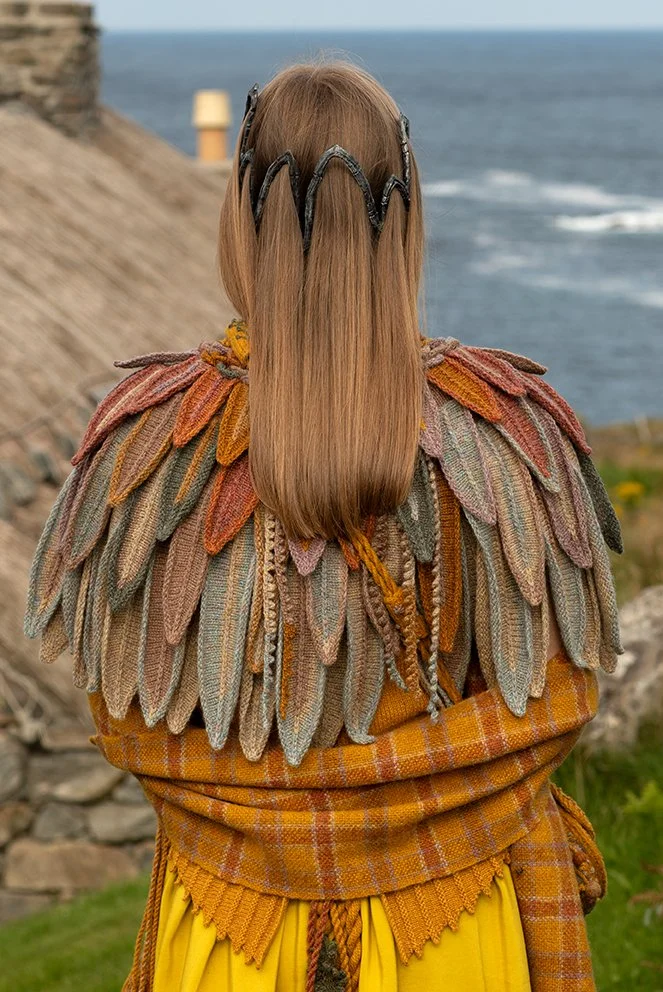
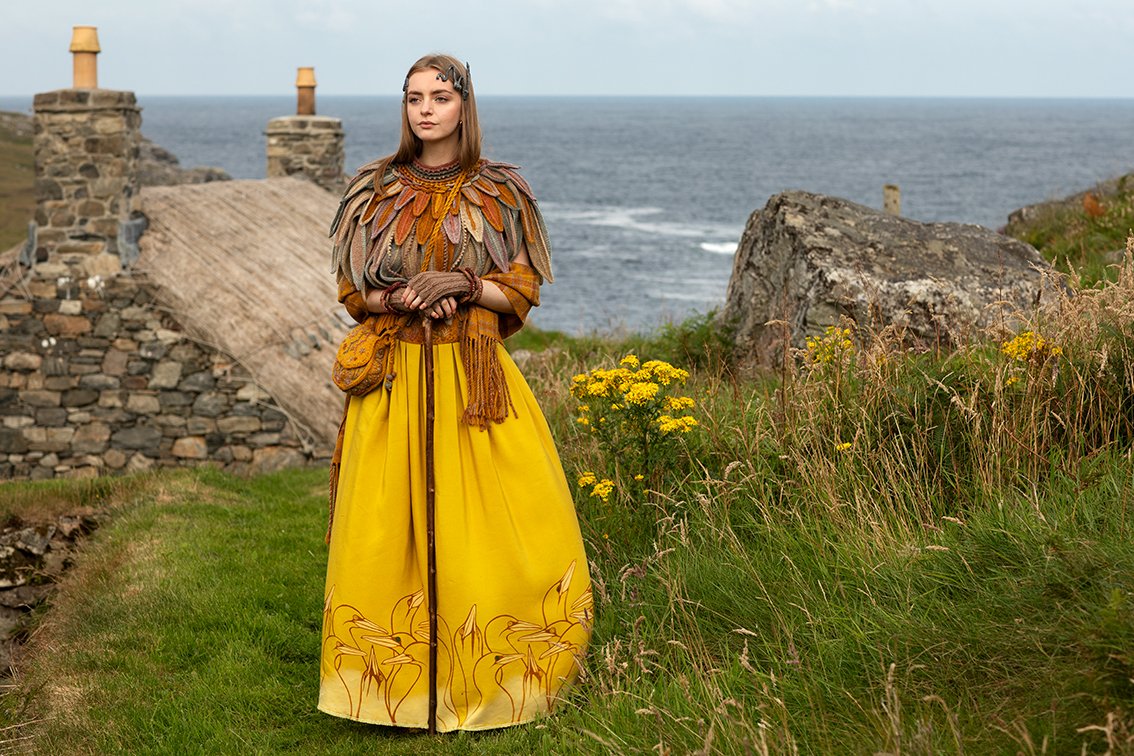
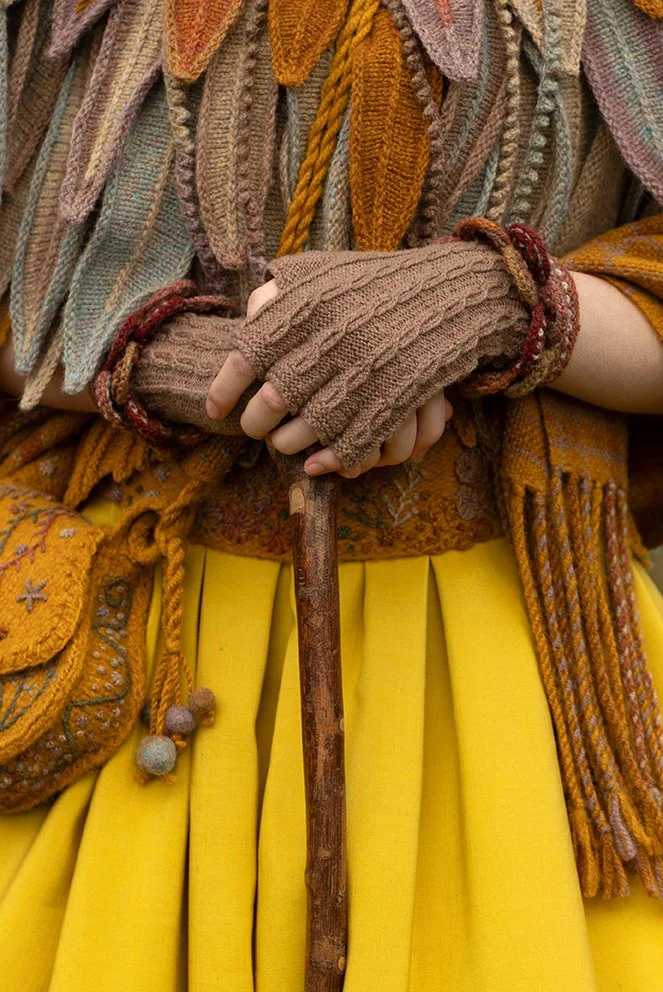
Raven Capelet, Sulaire Spencer, Sporran Bag, Breacan Wrap, and Ruabhal Gloves designs by Alice Starmore for Virtual Yarns. (if full length used) Boreray Dress fabric designed and made by Jade Starmore. Headpiece designed and made by Deniz Uster of Otherscapes studio. Modelled by Iona Mairead Davidson. Photographed at Gearrannan Blackhouse Village. Photography by Jade Starmore.